Poetry, Solitude and a Hundred Tortoises: An Interview with poet Zhou Li
4 min read
His day job is a hospital doctor, he raises more than 100 tortoises, and writes poems
Fish Lu: Please tell us about your day job first. Do you like your work? Why did you choose this career?
Zhou Li: My profession is a medical worker. For me, this is just a means to earn my living. It is just a job. I use it to get material things and to support my spiritual life as much as possible. The initial career choice was made by my parents. I always listen to them. I don’t like this job. There are too many repressive and helpless things in the state institutions, and extremely rational thinking is needed. But I’m a sentimental person.
Fish Lu: Please describe your daily life. Are you satisfied with your current living status?
Zhou Li: If you had asked me more than ten years ago, I would have answered: Satisfied, or dissatisfied. But not anymore. Basically, you have no choice: every day I go to work, get off work, occasionally write poems, and try my best to live as others do. You need to calmly face the various circumstances in life, whether proactively or passively. It is difficult for us to change anything.
Fish Lu: Why do you think you should “live as others do”? Is it because of the pressure from your surroundings?
Zhou Li: After all, life is trivial. You need to have various relationships with different kinds of people, and you can’t isolate yourself from the crowd, so it is better to have some commonality. I’m not exactly afraid of pressure, but I also want to be more relaxed.
Fish Lu: What kind of person do you think you are? Do you think other people’s impression of you matches yours?
Zhou Li: The opposites of many things coexist in me. For example, I sometimes can be very talkative, while sometimes very quiet, a great contrast. I can only keep looking for the point of unity among contradictions. But this point is constantly changing, so my status is continuously unstable and lacks a sense of security. I’m always worried that accidents will suddenly happen and beautiful things will suddenly disappear. On the spiritual level, it is difficult for me to find people who I can communicate with as equals. I think very few people understand me, and I don’t need others to understand either. Loneliness is my normal state. Perhaps most of the people I know still have limited thinking: we are not on the same level of communication.
Fish Lu: So you are a person with fierce internal conflicts. Have you ever thought about the specific sources of these conflicts?
Zhou Li: I believe that a large part of any individual’s destiny is actually doomed. This is not philosophical idealism. I think the real reasons are also there, but not as important. My father’s early death may be one of the reasons. At that time, I was an adolescent and my core values were budding.
Fish Lu: When, and for what reason, did you start writing poetry? What does writing poetry mean to you?
Zhou Li: I started writing poetry about five or six years ago. There was no special reason. I just started to write one day. Before that, I basically had very little knowledge of modern poetry. Later, maybe because of a girl, I then started to consciously write and showed it to her. She was my entire world.
Poetry is the natural outflowing of my emotions, meaning that I still have emotions, I’m still alive.
Fish Lu: You are relatively low-key in my impression, and now I also feel that you are a little pessimistic. Does this have anything to do with your experience?
Zhou Li: Yes, I am a pessimist, like the color black. You don’t see any shadow in black. In fact, there is a difference between pessimism and negativity or decadence, but many people see them as the same. My experience is terrible, no need to talk about it.
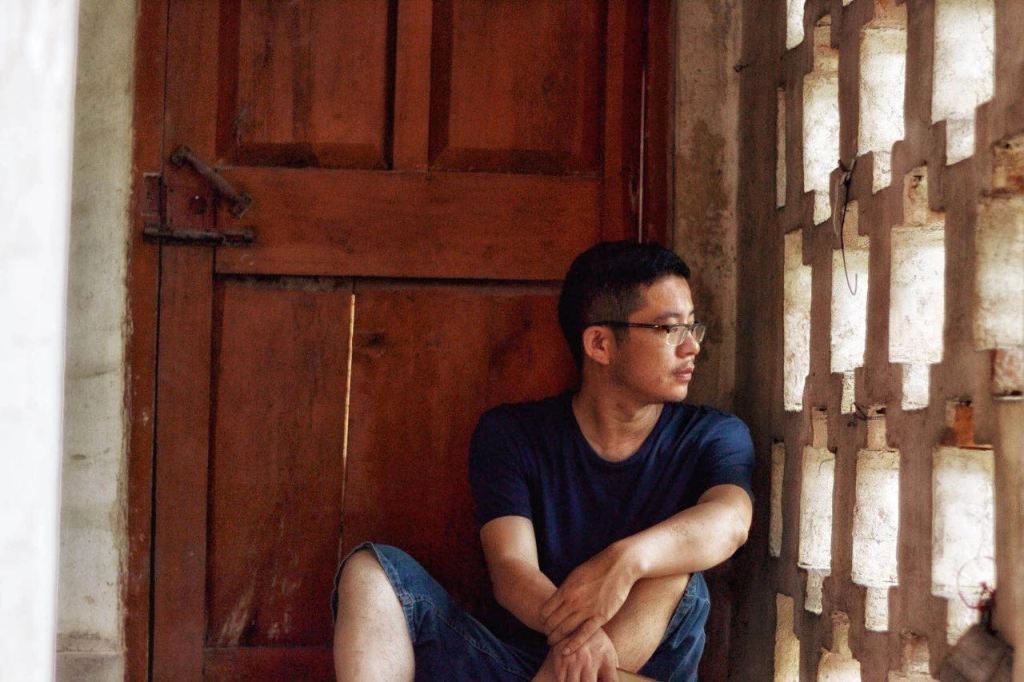
Fish Lu: Besides writing poems, what other hobbies do you have to fill your spare time?
Zhou Li: I listen to some music. I am a friend of many folk singers and occasionally I write songs, too. My dad was a morally lofty intellectual, and I have his genes. I usually spend a lot of time with flowers, birds, fish and insects. I have nearly a hundred tortoises and a few cats and dogs, and so forth. I feel that it is much more interesting to communicate with them than with humans.
Fish Lu: Wow, a hundred tortoises, this is beyond my imagination. Let’s talk about your tortoises. Is it usually troublesome to take care of them? How much time does it take?
Zhou Li: Ha ha, if you wish, you can accompany them all day long, feeding, changing water, taking care of the environment and hatching, and so forth. People who don’t have pets may not understand the hardships and happiness in it.
Fish Lu: Where are you from? Do you think the interpersonal or natural environment there has an influence on you? If so, what are the main influences?
Zhou Li: I live in a coastal town in Ningbo (宁波), Zhejiang China. People here live a peaceful and mediocre life. They basically have no influence on me. The only thing that influences me is emotion. I am a faithful slave to emotions.
Fish Lu: Can “a faithful slave to emotions” be understood as, like to immerse yourself in your own world?
Zhou Li: No one would be willing to be a slave, but I know for myself that I can’t get rid of my emotions, then maybe I should give myself in. Perhaps it will reward you with a piece of candy occasionally. I am a very self-centered person, but not closed. So emotion is the only way out.
Fish Lu: For you, what is the relationship between writing poetry, or artistic and spiritual pursuits, and your daily life and job? Is it possible for them to be in a compatible and harmonious state?
Zhou Li: Spiritual and material things are inherently intertwined with each other. It is impossible for one to exist without the other. There can be toleration, but that’s not harmony. Poems are the body and spirit imprisoned by me. I always have to stay with things that I don’t like.
Fish Lu: Are there any poets or artists you like?
Zhou Li: There are a few. For Chinese poets, perhaps Wu Qing (乌青), Ren Hang (任航) and Yang Li (杨黎). For foreign poets, I like Philip Larkin and Charles Bukowski.
Fish Lu: What do you usually talk about when talking with people?
Zhou Li: When talking with different people, my state will fluctuate greatly, and the specific contents will be different too. If he or she has an interesting soul, I will naturally talk about something interesting: poetry, love, politics, worldviews, and the damn life.
Fish Lu: Seems that the topics can be very diverse, and you’re a bit cynical. Do the people around you have such an impression, too?
Zhou Li: Yes, they do. There are many things that make me angry. This is a matter of principle. I habitually see the other side of the coin.
Read ten poems by Zhou Li ↗︎.