We Are Different and Connected: Jayanta Bhaumik in Conversation
10 min read
Writers in Conversation || For Jayanta Bhaumik, writing is closely tied to the ways we understand ourselves and connect with others. In this conversation with Whale Review, the Indian poet recalls his childhood memories of rivers and passing trains, reflects on what draws him to poetry, and considers how his work in mental health has shaped his understanding of people. He also discusses personal encounters, literary influences, culture and tradition, and the connections that exist between us despite our differences.
Whale Review: Where did you spend your childhood? Could you tell us a little about what it was like?
Jayanta Bhaumik: I was born in Kolkata, previously Calcutta, it's an old metropolitan city in India. But, my family, for a few years before finally settling in Kolkata, had to move to Howrah, an area with a small industrial belt, with the river Ganga flowing by it. I was in a small convent school, Crescent Moon, my younger sister had not yet been born. My dad was a Public Sector Undertaking employee, and my mother was a high school teacher, with a proficiency in language and music. It was a different childhood, some forty five years back, when, after returning from school and a little routine studies, my mother and I would make our nearly daily trip to the river strand. It was most probably during that time when I had developed a surreal feel about the people, their life, life around me, and also the inside-world reigning within or roaming within the stark outside, rather subconsciously.
I remember, sitting on a particular cemented slab – and really not a typical concrete bench in particular, just at the stranded pathway, my mother at times used to sing: she used to sing, apparently, to me. But, as I look back, she perhaps would sing really not to me, with her very, very low tune, but to herself; but to the river and world around, to her own heart, to her heart's content... I remember, we had a transistor that time at our house – a common to all houses, but there was no television; we had our first colour-television set some time in early eighties ...
I can't say if it was a colourful childhood, or colourless; I have no idea what could've or might've been so much of a colour in my childhood; I had a resonance of contentment, which surely would never have been an uncoloured one.
While returning to our home, we had on our way a railway track that we had to cross. It was a track not really for the passenger trains, but wagon-trains. We used to stop, while the train would have to pass, with my face bewildered at a few facets connected with such suddenly-passing wagon-loaded trains: where was it from? where was it supposed to reach? how should I have to feel had I been its guardman standing at the last roofless small bogie allotted for the guardman? etc, etc.
It was an industrial belt, so the bogies I used to see at were loaded with various materials, from plastic products to wrought iron to coal and other such mineral items ... at that age, such whistling trains were among those ones that I had first fallen in love with in those years ...
We eventually had to move to another small town, where I found a similar railway track. By then, my younger sister had already been born. For me, it was so unfalteringly fascinating: a similar railway track again ... I remember, as we had finished our dinner, we four ready for our sleep by 10.30pm around, I could remember the haunting image of the passing bogies... I still can feel I’m bearing that old reminiscence, an entire composure resonant with railway tracks, train-engine whistling, dinner time, and a ten-year old boy remembering the whooshing view of a train with no whereabouts of its destinations.
Whale Review: When did you first begin writing poetry, and what does writing mean to you?
Jayanta Bhaumik: I remember I had written my first poem in English language for their souvenir of a College in England, it was almost irregular, but they used to do it very sincerely... my first online publication was in Poetry Superhighway, title, “unborn,” still online and edited by Rick Lupert.
It's now been next to impossible to calculate how long I have been asking myself, again and again, whether I truly wanted to write. If yes, why? Why isn't reading books alone sufficient?
Perhaps, I can best elucidate, words have their own way to choose one to renew themselves: and this was the way I finally got a slight, rather hesitant affirmation from deep down inside of me. All the lines are already written, that too so pretty many times, but they again choose you for a transitional renewal... they need yet another dimension. And it's your way that's destined to be that dimension... Writing for me is more or less an experience of my own, both easy and difficult experiments with words that represent thoughts -- and that decode man's psycho-physiological journey; man is to understand himself, people around him, and life as a whole. Every word contains a secret code, as I think, that is waiting to be cracked by your way to understand...
That's how I feel of the meaning of writing as far as my poetries are concerned. With assertiveness or regression, the usage of many words takes a particular form of understandability... you can put a word, a phrase, a type of metaphor into a different mould, and your poetry may create the other voice than usual or already known, voice that you call a particular expressiveness.
Whale Review: When do you usually write? What kind of writer would you like to become?
Jayanta Bhaumik: In fact, there's no fixed time for writing; although, evening, then late evening, seems so far a better time than the rest. But, sometimes, not very often, it's a little late night, too. And, if my mood is so charged, at late noontime too, I write my poetries, making rough or initial sketches, certain ideas and idiosyncratic applications if needed... There's actually no fixed routine, but I find the latter half of the day preferable.
What kind of writer I truly want to become, if that’s the query, I can then ask, very humbly myself, what kind of writer I have already become by now … If I honestly speak, well, I truly have no stipulated target of becoming of a writer – that to say, any such target of attaining a fixed writership ... The universe has decided all along what, and how, I should turn, and become, turn, become, so on, so forth, it's how I have been chosen – and, truly speaking, if deeply considered, at least in my own case, it hasn't remained my conscious choice ... It is an entire process of lifelong becoming ...
But, well, if seen that way, I opt to remain in a becoming of a writer who speaks about man's understanding of his own understanding, and of his own world at large ... and, I wonder, has it really been possible for me to write a single piece like that?
Whale Review: Do the people around you know that you write? Do you ever talk about your writing with your family or colleagues?
Jayanta Bhaumik: Yes, my family and my close circles, they all know about my writing, although not much personally involved... except my own younger sister, who has many times taken initiative to inspire me, even at periods of what's typically called writer's block. Initially, decades ago, I had a small circle of regular readers, which have now been scattered off.
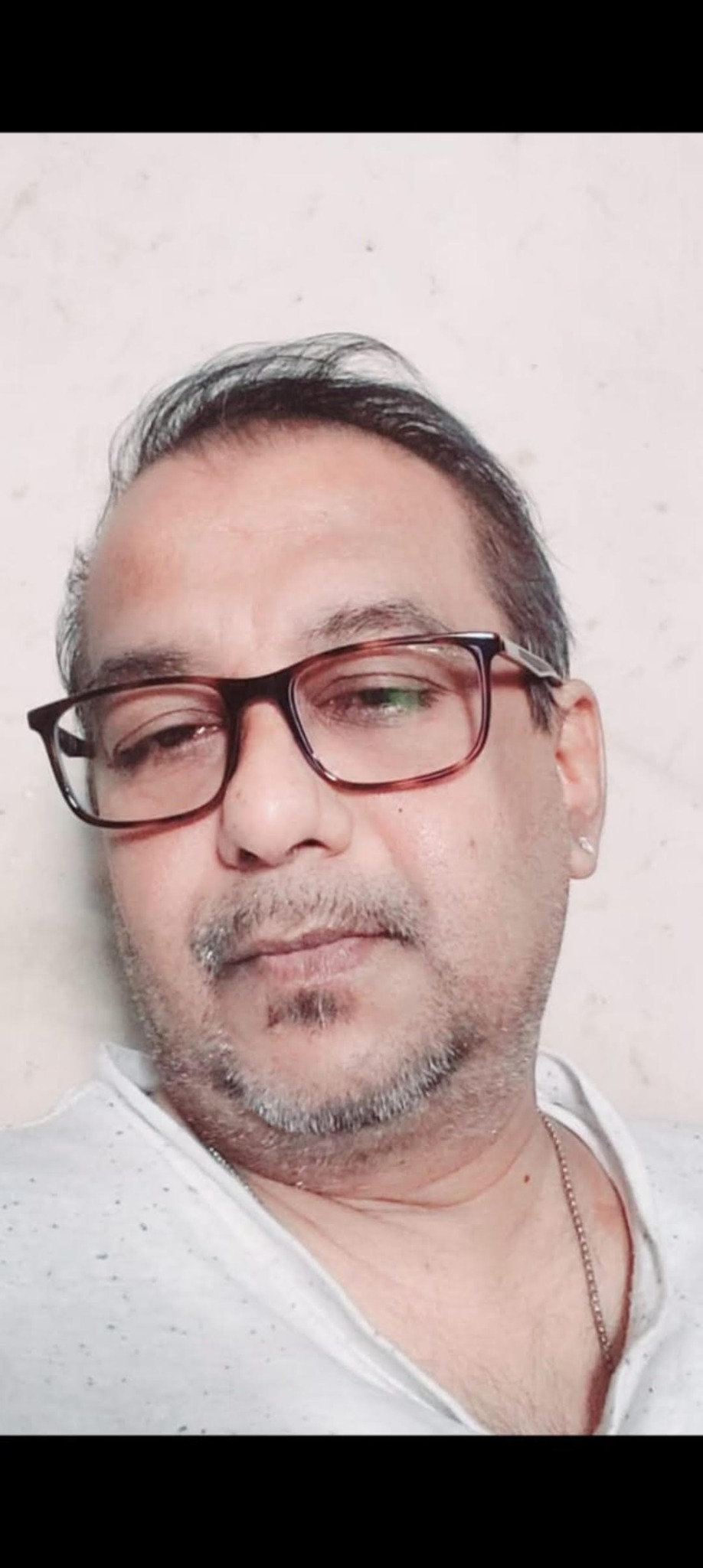
Whale Review: We understand that you work in the field of Mental Health & Counselling, and your poetry often explores people’s inner thoughts and feelings. How would you describe the relationship between your profession and your writing?
Jayanta Bhaumik: Luck must have played a huge role in it, or, in other words, the universe has wanted it in this particular shape. I cannot really say how, or why, in which exact way, I pick up an experiential counter and write about it in the colour and form of a poem… I am not a clinical psychiatrist, so my work is not really up with pathological expertise. My work involves dealing directly with people's psychological concerns, their troubles at times so critical that they feel like they themselves do suffer a failure to understand their own problems. I mean, the way it goes in my professional field. I won’t be elaborate; instead I will put down here a very small, almost a minute episode to help understand how writing becomes (or, may become) an inseparable part of understanding that is required for one like me in the entire composure.
My jobs have undergone spans when I have made repeated trips to various cities in India, and also in a few countries in southeast Asia. It was once when Singapore used to be my place of long, repeated stays ... I have stayed mainly at Lavender and Geylang main areas ... Parts of such places I know like the back of my hand ... I can remember the then time, when I had my base in Singapore, from where I was then travelling to the Philippines… it was after a conference, followed by a six-day long workshop, that I was sitting at a little less crowded space. By my side, was sitting a guy, who was rather a new recruit in our team, and an assistant type, not till then included in the mainstream curriculum. I was then thinking something, and, the guy, that assistant fellow, originally from Malati, a place of Manila City, who wasn’t really from my very close friends' circle in the Philippines, had asked me what I was busy with in my mind... All of a sudden, he had asked, "Are you a writer, too?" I got startled, naturally, nothing was written on my face. And, surely, at least he wasn't supposed to know anything ... I shrugged a bit, just to avoid, and he kept saying, "All writers should always know one line, always..." "...and what’s that?" I turned bemused, of course... What he said was so, so important a fact far, far more than being poetic, romantic or philosophical … Perhaps, all men bear a commonality unknown to all of us, perhaps we all carry a line whether we write or don't. Perhaps. I really don't know. Beyond all imagination and creativity, we all know what we want to share with one another ... I shall never forget what he had told me... "... it is, in Filipino, 'Mahal na mahal kita' " meaning, I love you, I love you so much...
If I express myself truly and humbly, I perhaps know the fact that, through the mind-world, everyone carries his or her vessel full of thoughts, imaginations, and questions loaded with emptiness or loneliness. Everyone has a connection with their inner world, called the mind, which has its own state of health... We think we know and understand this health, and we do things to promote certain feelings of well-being. Feel-good factors are dicey, the undercurrent of which are expanded through innumerable aspects of life and the world at large ... I must say I find myself very, very feebly able as far as such collection of elements are concerned which I work out in my writing ... if you can translate 0.01% of your understanding, or put them in language, it can surely be said, well, that you are able to produce a fat book of poetries quite with your complacency.
Whale Review: Some of your ideas are very interesting, such as the idea that language renews itself through writers, and the idea of looking at certain questions about ourselves from the perspective of the universe. Do these ideas come from Indian culture, or more specifically, Hindu culture? How do you approach the relationship between traditional culture and modernity?
Jayanta Bhaumik: It is undoubtedly a very interesting query ... but, my reply is rather quite simple, as I humbly believe, my sense of universe has really nothing at all to do with my being Indian or Hindu, surely not. Religiosity is rather a smaller counter of codes and conducts, that to say … If I become honest, and truly candid, well, I can say, when I talk about universe I want all to understand the universal network that we belong to ... It is how we have remained assimilated through the bonding of humankind since time immemorial. Carrying goodwill and selflessness brings all of us together, without any involvement of any Religion. All primary religions finally deal in man’s endless journey of seeing himself evolved to a far better, greater and surer being, – what can be more universal than this approach, if really thought and considered.
We accept it or not, the universe does accept us in order to get us bonded through its current of interactiveness ... in which, we all are different and connected, united with all our unique idiosyncratic traits; but, of course, it is unity, per se, and surely not uniformity ...
As long as the difference or concoction is concerned with respect to tradition and modernity, I think all traditions have a need, also an urge, to welcome modern perspectives... A bog filled with water with old, unchanged stuff is a place never welcomed... it is rather a good thing to view a running water stream, a passing flowing river that takes all sorts of challenges, even obstacles and challenging buoyancies in order to always build places for new life on both its banks... this we bank upon, this type of banking upon modernity should be something to be called a tradition.
Whale Review: Do you enjoy exchanging ideas with other writers, or do you think you can do just as well without it?
Jayanta Bhaumik: I always believe in interactions, and exchanges of many pursuits, if not most ... that's enriching, and, if that's how I can put, I feel I'm an open-minded person with windows open for fresh airs ... Maybe we can't like everything all the time, that is life, that's how we build up ourselves through so much unknown around us.
Whale Review: Have you ever had a conversation with a stranger that you still remember vividly?
Jayanta Bhaumik: There are practically myriads of events or incidents, of so very many amazing types, in anyone's life ...and, being in such a profession, meeting strange or unimaginable incidents is what happens quite at a regular interval...
Amid so many, I had met a lady, in Kuala Lumpur, in 2016, who absolutely took me aback, as I was waiting for my returning flight... when, after certain intricate enumeration of her life-story, about her drug-addicted son then slowly coming back on the track, she sighed saying, I wish you were a counsellor ... I was startled like anything, kept silent for some seconds, -- what was it? I still keep wondering over such events, as I can't help being amazed when people have come across me and expressed something as if they were the natural sleuths, by default, by the course of nature ... how one talks about my being a counsellor or a writer, is as much a mystery to me, as it divulges out a subtler understanding of universal connectedness ... this universe is a strange field of sequences and consequential ROMP -- Randomly Oscillating Magnetic Pendulum. This is both science, and as well what remains only through your larger understanding of the self, this world at large, and the life of humankind ...
Whale Review: How do you usually spend your free time?
Jayanta Bhaumik: In my daily schedule, it's very difficult to come conclusively to a point of getting, that way, a free time for leisure ... Having considered my kind of profession, there are times when I remain absolutely free, what is commonly understood by the word "free". My hands, all free no doubt, not my mind, of course ... that said, I am scared if I really do keep free at all -- you know what it means ... A constant resonance goes on, even if I don't do my professional work, or write a poem ... I believe, there are many like me, whose free hours are, in all actuality, filled with lots of preparatory aspects for both the next case or next poetry. If that's really how I can best, all humbly placing, give a description of my "free" hours...
Whale Review: Thank you very much for taking part in our interview. Finally, which writers have influenced your own writing the most? Could you recommend one of your favourite writers and a book by them?
Jayanta Bhaumik: I should say I am influenced by an array of poets and writers... My childhood had a facility of being gathered books of so very many types, so many Indian and English books of literature... There were literary books of other languages, too, translated into English, we even had Mikhail Sholokhov's And Quiet Flows the Don (I had once started with volume one, didn’t complete, honest enough) ...
To be specific, other than Rabindranath Tagore, the Nobel Laureate poet from India, who had built up a fresh voice in English, I have remained greatly influenced by Wordsworth and Tennyson, more Tennyson than Wordsworth, among many others ... and, Whitman, I keep mumbling to myself lines, like, "We were together. The rest I forget". Or, "Keep your face always toward the sunshine – and shadows will fall behind you". (Editors’ note: The quotations are commonly attributed to Walt Whitman, but these attributions are disputed.) Amid modern novelists, Garcia Marquez is unsurpassable, for me. Among others in English, Ben Okri (especially his The Famished Road), Rushdie and Ishiguro I usually keep always by my side.
Featured Writer: Jayanta Bhaumik is from India, works in the field of Mental Health & Counselling. His past or recent works can be found in Poetry Superhighway, The Gorko Gazette, Madswirl, Tap into poetry, The Candyman's Trumpet, Lothlorien Poetry Anthology, Fevers of The Mind Anthology, 100 Poems for 21st Century by Rough Diamond, The Leafline Magazine, and elsewhere. His first poetry chapbook "Creeping Legends" was published by Alien Buddha in December 2025. Twice nominated for Best of the Net. His X is @BhaumikJayanta