Sentencing Sentences
2 min read
One could say tell me something new but that would be missing the point is how my writing has been described, is what I sometimes oftentimes almost always hear from my dear friends after I send them a work.
That regardless of whatever it is I am purporting to be writing about, to be making marks on, I am somewhat actually writing the same thing, am always re-writing the same piece.
And that, at the very same time, even as they might be seeing a familiar set of words, similarly-arranged letters of the alphabet, there is something that is not quite the same; that what they see, maybe even hear — perhaps even encounter — is same same but different.
Where there is a possibility what is seen, what is heard, is not quite the same: even as they are only heard and seen in and through what one might call reading.
Where what the point is might well be what remains missing between what is seen and what is heard.
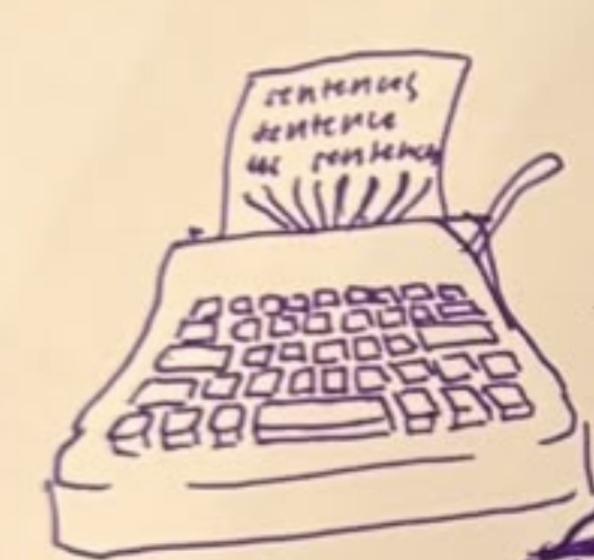
Then again, I rarely know what I am writing about, let alone what I am attempting to write; sometimes I barely even know what has been written after the writing has allegedly taken place.[1] Which opens the possibility there might be a difference between writing and the marks that are made: which is quite possibly the difference between graphein and scribere. Not that one might ever be able to fully differentiate between the two.
Nor tell who is calling them into being.
For, we can never quite be sure if we put our sentences into order, or if they order us — after all, sentences sentence us, but only at the moment in which we call them into sequence, make them into a sentence.
Nor are they mutually exclusive.
Perhaps the only difference, at least one of the differences, being: when you are sentenced, you are often dumbfounded; making or being confronted with a sentence occasionally has the opposite effect, though not necessarily so.
Shiny, shiny, shiny boots of leather
Whiplash girl child in the dark
Comes in bells, your servant, don’t forsake him
Strike, dear mistress, and cure his heart
~ The Velvet Underground
You could well sentence a sentence. You can only be sentenced with a sentence. Only sentences can sentence you. Keeping in mind the fact that every sentence has been sentenced to grammar, even the most a-grammatical of sentences.
Notes
[1] This is particularly true when I am doing one of my performance-readings: it feels as if I’m reading something entirely new, not exactly completely unknown but close-to-being-so; as if what I am reading were written by another hand, one close to me without any familiarity (as Hélène Cixous might say).
Author: Jeremy Fernando, reads, writes, and makes things.
He works in the intersections of literature, philosophy, and art; has written more than 30 books; and been translated into 11 languages. Exploring other media has led him to film, music, performance-readings, and the visual arts; and his work has been exhibited in Seoul, Buenos Aires, Berlin, Vienna, Hong Kong, Lisbon, and Singapore.
He is the general editor of Delere Press; curates the thematic magazine One Imperative; is the Jean Baudrillard Fellow at The European Graduate School; co-creator of the private dining experience, People Table Tales; and the writer-in-residence at Appetite, the sensorial laboratory exploring the cross-roads of food, music, and art.