I Don’t Know When to Stop Reading and Start Writing: Jeremy Fernando in Conversation
13 min read
Writers in Conversation || In this interview with Whale Review, writer Jeremy Fernando talks about growing up in Singapore, his early experiences of reading and writing, and his relationship with literature. He also shares his thoughts on creativity, boredom, and everyday life. Throughout the conversation, he returns to questions of language, the nature of writing, and the possibilities that emerge when we remain open to the unfamiliar.
Whale Review: Where did you grow up? Could you tell us a little about your childhood?
Jeremy Fernando: Physically in Singapore, where I am still primarily based. Psychically, intellectually, perhaps even emotively, elsewhere.
And it was this elsewhere—by way of places, spaces; also worlds, in books, films, music, visual artworks—this simultaneously always being elsewhere, which helped me make sense of the unease I had felt whilst growing up. Such as how much I hated the school system and its obsession with exams, testing beings, sifting out whether people were “good enough” according to a narrow, blinkered, parochial, rather moralistic, version of the world (and if you “didn’t make the grade,” you’ll have a lifetime of people telling you “you’re not good enough”; the worst perpetrators tending to be those who pride themselves on being called “educators”). Above all, the unease of not wanting what most everyone around me seems to have wanted—careers, climbing up ladders, positions, titles, status—to want, to continue to want.
Eventually, slowly slowly really, it took me much longer than some of my wiser, more astute, friends, I started to realise my unease lay in a growing realisation of how transactional Singapore is: nothing is valued unless it can bring surplus (by way of price, status, worth); which also means, nothing is intrinsically valued, even people. Just look at the way we treat our indentured workers.
Which really should have been no surprise: after all, Singapore is first and foremost a port-city, and its defining features are movement, flow, exchange. But this is something that only comes to you with a little distance. Probably also why I really hate the phrase, “spending time,” which implies a transaction, sometimes investment, even an aim of profit (in whatever form). I do prefer to think of it as sharing time, with people, places, works; and whenever possible opening myself to them, letting them write onto me, then attempting to read these traces.
In this sense, Singapore is familiarly-strange to me: where I am a stranger—not completely, of course—so a friendly-stranger, one standing on its threshold; questions of hospitality are always involved, especially in these dark moments where guests are treated with suspicion; and hosts are increasingly pressuring everyone to assimilate (in itself, a form of kidnapping; surely Zeus would sigh at what is happening to xenoi, to anyone regarded as strange). But it is also at these thresholds where you can potentially attune yourself to possibilities of the I writing-with (which is what I see myself as doing, at least trying to do). And by immersing myself in the (un)familiarity—and attuning myself to the strange in the everyday, of trying not to let the quotidian be fully normalised—I hope to be able to see, discover, listen to, what emerges in that submersion: c’est-à-dire, l’ailleurs en moi.
Also why I am really grateful to have grown up amongst multiple languages—English and Malayan-Cantonese at home; Bahasa Melayu as a second language in school; Singlish and Mandarin among friends; a smattering of Hokkien and Teochew with neighbours—so alongside different words, thus worlds.
And ways of seeing.
Whale Review: How has growing up in Singapore influenced you, and in what ways?
Jeremy Fernando: Growing up and living primarily in Singapore places one in an adjacent, at best—precarious, if I were to be truly honest—relationship with literature. Especially if literature, if Jacques Derrida were to be believed, is a form most aware of itself, which lends itself to be read (lit) under erasure (sous rature). Or in my reading of him, where an emphasis on lit is accented: où la littérature, c’est ce qu’on lit au lit, where literature is what is read while on a bed.
Precarious, as the shifting sands of literature make states like Singapore nervous: for, despite what those with authoritarian-bents would prefer, one can never quite take control of the narrative, nor can stories be limited to their preferred versions; nor can you control them, how they would be read, another fiction people who give themselves titles aplenty like to hold on to.
And in its foregrounding of the potential fictiveness of the author, our reading—our living with literature—always also reminds us of the almost-groundlessness of origins, auctor, and authority. A lesson our subversive civil servant friend in Prague never lets us forget in trying to show us the world lying in front of our eyes: the world of bureaucratic absurdities hovering above, below, within, our lives we refuse to see, that we have resorted to naming Kafkaesque to maintain the illusion it is “there,” away from us, where we are not.
Which is probably what drew me, many moons ago, to the scene of our friend in literature, Oscar Wilde, lounging on a rock in Merrion Square Park, Dublin; also to The European Graduate School (which is not so much a philosophy school as a school that thinks philosophically; in a way existing in a parallel universe to many contemporary universities, and at which a seminar is truly a space not just for, but also of, thinking); to particular teachers who took the question of language seriously and simultaneously playfully. All of which and whom have shaped the way I have learnt to read, to write, to read-write-be with the world.
I thank them all.
Whale Review: How did you first begin writing?
Jeremy Fernando: Like with most good things, I think it’s a good thing, at least hope so, like with many good things in life, it was an accident. I was, then, doing my Bachelors in Mass Communications as I had thought I wanted to work in advertising. At that point, I wasn’t enjoying my undergraduate experience—and frankly, barring perhaps 3 professors, found the place intellectually bland—but in a rather happy accident stumbled upon what has come to be called continental philosophy, and eventually the EGS where many of the people I was reading were teaching, while I was there (boredom does bring about some fortuitous moments) and found myself reading more and more and more of it.
At about the same time, I was doing a copywriting internship at Ogilvy & Mather where I had the good fortune of meeting a lot of lovely people who were really good at what they were doing, which led me to have, and continue to have, a real appreciation for the craft involved when things are done well. Which also led me to realise I wasn’t cut-out for that particular approach to writing; or, if I were feeling more generous (and why not, if there is anything I am, indulgent would be it), the craft of copywriting didn’t quite call out to me. One of my mentors at O&M, Pei, who is an amazing art director—and a wonderful painter and artist—also made a rather astute observation that not only was the kind of writing I like almost diametrically opposite to copywriting (which is a form of invasive propaganda in the precise sense that it has to propagate a message despite the fact people are either not aware of it or even actively trying to ignore it), my personality would probably not take me very far in the industry (which is a bit of a “you need to shout to get your ideas heard” environment).
Which helped me realise (thank you Pei!) what I really like are silences. And eventually, slowly slowly, led me to the kind of writing that truly calls to me. To Marguerite Duras, for instance, who teaches us, “écrire, c’est hurler sans bruit,” that to write is to scream without making a sound.
Silences, in what is left unsaid, even silenced, remaining to haunt our texts … if only we learn to listen.
Which is probably why questions, so possibilities—alongside the impossibilities—of testifying (Writing Skin, 2020); bearing witness (i’m not ghosting you, 2025), their accompanying lyings, rewritings, accusations (Jeremy Fernando by Jeremy Fernando, 2025); mourning (Writing Death, 2011; Eating well with Anne & Pierre, 2027); longings (I wish we were lovers, 2024); betrayals and love (in fidelity, 2016; translating love, 2026) are woven into my work, often in deeply personal ways.
Whale Review: Your writing spans several fields, including philosophy, film, music, visual art, and even personal experiences on food. What led you to explore such a wide range of subjects, and how would you describe your writing practice today?
Jeremy Fernando: Without meaning to sound flippant, I truly believe writing comes to me, that what I write on (write-alongside might be more accurate, I think) are things—ideas, questions, people, moments, experiences—which call out to me.
I primarily think of myself as someone who tries to read, who tries to open myself to the possibilities of texts, people, places, spaces, happenings. I wouldn’t even call myself a reader as we are not nouns. I suppose you could say: I try to read things; in response to what I read, think I am reading, I try to make things in response to them … that’s pretty much what I think I do.
I think Kathy Acker calls what I’m trying to do “writing with other texts.” I would also call it getting out of the way so the text can write. And this is by no means a disavowal of what is written, what I have signed-off on, have underwritten as it were: after all, we can never know if something is an idea we have thought-up, if a thought has come to us, if it were merely voices in our heads (not that the three can truly be distinguished, let alone delineated).
All I can really say is about my writing, my approach to writing, and the writing I try to make is: writing is my primary mode of not just expressing thought, but of thinking itself. And, whenever attempting to write, I try to maintain the possibility of conceiving writing as scribere, scratching—onto, into, out of—tearing, opening; as an attempt at maintaining questions, perhaps even quests, in what is inscribed. And this relationship—between what is posited and the question that remains—is something that I attempt to explore intensely, to intensely explore.
Or, perhaps, it explores me—and I writhe.
However, being open to possibilities means I have to concede I am never quite in control of my thoughts, my writing. Sometimes whatever is written is strange, unfamiliar, other, to me … a fragment of me. And I can never quite control how it will be read: I can only write, read, and leave it to be read.
That is the risk of writing.
As one of my favourite writers, Virginie Despentes, puts it in her inimitable way: “there is a genuine connection between writing and prostitution. Emancipating yourself, doing that which isn’t done, opening your private self, laying yourself open to the judgment of others, accepting the exclusion of the group.”
And I suppose the only way I know how to try to remain light in light of these risks, these responsibilities—particularly the one of potentially speaking-over even when trying to be as faithful as possible to the voices I am trying to channel, be a medium to—is to attend to the craft of writing while remaining distracted. This mostly takes the form of having multiple conversations: with books, tunes, other people, virtually or otherwise. And oftentimes, it is these dalliances which open new textual possibilities I was blind to.
Hence, friendships are crucial to my writing: friends have an effect on you, can sometimes open a question in you, might well affect you, unveil a new register, perhaps inseminate a thought in you, might even infect you—my writing is syphilitic. A boy can only dream.
Socrates had a daemon that whispered into his ear; the Romans had a genius which struck them;
I have a bottle of gin (ideally with a twist of lime) … mmm dreams …
And I suspect, over time, I’ve come to terms with the fact it has taken me years to admit, and then, perhaps only to myself, I don’t care about writing something important, something significant. That my only hope, wish—dream even—is to write something beautiful.
Ah, a boy can only dream …
Whale Review: From your perspective, how has the literary landscape changed over the past fifty years?
Jeremy Fernando: To be honest, I don’t really pay attention to literary movements, even less so trends: I’m more interested in writers that bring a smile—sometimes in happiness, sometimes wryly, sometimes in amusement, sometimes in surprise (I move a lot when I read)—to me, even better if my hands start waving around (with a massive apology to all the people who might have been next to me on a train).
Some writers I’ve read in recent years whose words, so worlds, I adore, include:
Constance Debré, Virginie Despentes, Christina Tudor-Sideri, Nate Lippens, Brian Willems, Yeoh Jo-Ann, Fernanda Melchor, Adibah Mustafa, Jen Calleja, Daniel Davis Wood, Julia Kerminon, Lauren Elkin, Sara Baume, Valeria Luiselli, Cyril Wong, Ming Cher, Alicia Kopf …
Favourites I’ll always return to:
Hélène Cixous, Marguerite Duras, Dorothy Sayers, Avital Ronell, Chris Kraus, Jean Genet, Jean Baudrillard, Judith Balso, Pierre Alferi, Anne Dufourmantelle, Juan Rulfo, Yang Lian, Jacques Derrida, John Berger, Michel Deguy, James Baldwin, Dai Sijie, Eugenio Montale, Franz Kafka, Jorge Luis Borges, Italo Calvino, Philippe Beck, Jacques Roubaud, Werner Hamacher, Sylvère Lotringer, Pierre Guyotat, Georges Perec, Flann O’Brien, Jon Fosse, Eduardo Galeano, Enrique Vila-Matas, Valerie Solanis …
(with a mea culpa, mea culpa, mea maxima culpa, to all of the writers whose names have slipped my mind; or perhaps—rather wisely—would rather not be associated with me )
Alongside—and I hope you forgive this potentially shameless plug—all of the writers, thinkers, artists, makers, we’ve published at Delere Press (at which I play the role of general editor).
Whale Review: You have a remarkably wide range of reading interests, and there seems to be a complex interplay between your reading and writing. How do you maintain your independence as a writer within this relationship?
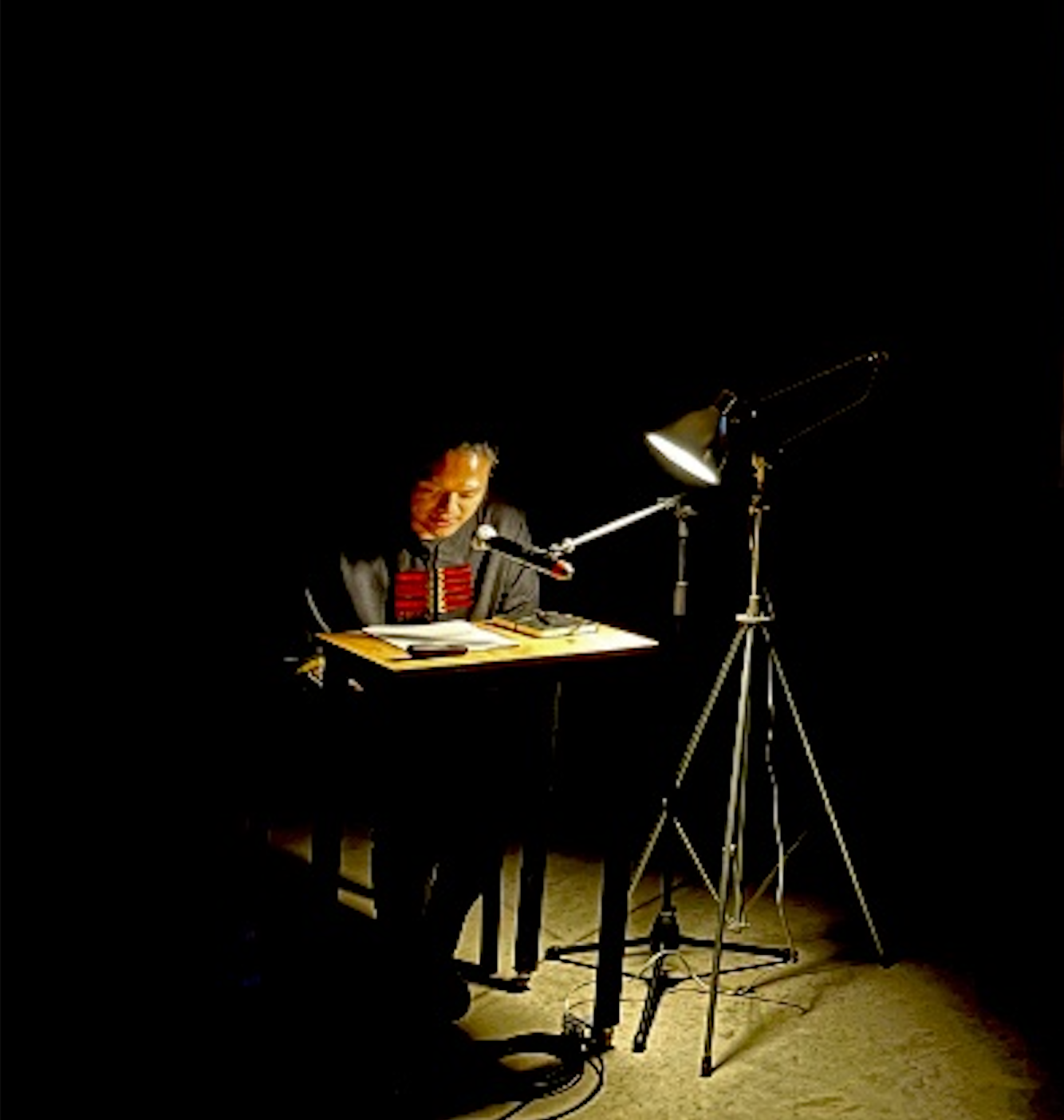
Jeremy Fernando: To be honest, I don’t really see it as a need to separate my writing from what I’m reading: for me, reading and writing are—whilst individual crafts—rather indivorceable from each other. Which is not to say this question hasn’t nagged at me for quite some time: it first came to me sometime in 2023 during a month-long residency at HANGAR in Lisbon, and it resulted in me devoting my performance-reading at the end of my time there to the question, “when is it time to stop reading and start writing?”
The short answer to it would be, “I don’t know.”
And this question has continued to linger in me, and has since followed me into my meditation on translation (which itself is a form of reading-writing, writing-reading); and if I had to posit, take a position on, where I situate the work I make in relation to reading and writing, it would lie in that hyphen.
Probably because I suspect a large part of my work, and how I make works—so how I write really—involves bringing words, so worlds, together. This is something a dear friend, Adibah Mustafa (who writes some of the most gorgeous prose ever, she is an infinitely better writer than I could ever be) pointed out when she very kindly wrote in response to one of my works: “At the heart of Fernando’s approach is the exaltation of citation and annotation: each one constitutes in itself a longing to remember and to relate, manifesting as an act of translation, for it gathers something from ‘there’ and carries it over ‘here,’ where it quickens, as much as it’s quickened by, a new fit and form. What he takes from other texts in order to gift to, and through, this text Fernando sees as a waltz between two integrities, charging, electrically, one with the other—between what can be known and what still resists being known, what has been expressed and what continues to elude expression. And while both share a certain riveted centre of common ground, of contexts touching and tangling, complete communication (as in reach) or comprehension (as in grasp), with its companion air of finality, is an undesirable impossibility. Where a citation might lead, and nothing but unnecessary might follow, or vice versa, cannot fully be clear simply because it should not be—and Fernando performs this Janusian dance with confidence and compassion.”
I recall, many moons ago, asking my dear teacher, Avital Ronell—while we were on a walk in the woods in Saas Fee—what she does whenever she encounters “writer’s block”: “I pull a few books from my shelves, without necessarily knowing why these particular ones, and then move them about on the table into a configuration that feels appropriate, even right, then open them relatively randomly, and read a few lines. Then I try to listen to them as they speak to each other.” This is something I do all the time, whenever I start anything.
Come to think of it, I suspect that was what Hélène Cixous was trying to tell me, a few moons ago, when I asked her how she begins her works: “read everything.”
And if what you read—be it texts, people, things you see, eat, drink, conversations you hear, encounters which happen to you—if what you read writes itself into you, affects you, even causes you to writhe, there is (maybe) the beginnings of writing.
Whale Review: Do you have a regular time set aside for writing each day, or can you get into a writing mindset at any time?
Jeremy Fernando: No, not at all really. Writing comes when it comes. All I can do is try to be as ready as I can when she does: by having a notebook; being in front of a keyboard; scrambling to find something to make marks in, often the book I am currently reading.
I do, though, like to start the day by reading, and tend to get a little grumpy if something else gets in the way of that.
Whale Review: Do you often feel bored? As a writer and thinker, how do you view boredom?
Jeremy Fernando: Hmmm, not really … restless maybe, which to be fair might well be a form of boredom; one in which the world still calls out to you. That said, it’s not as if I can—or, to be honest, am interested in—picking up all calls; and how can one?
I suspect, though, my main emotive response is a kind of wry amusement. And I do tend to find most of life rather absurd, considering so much of the sadnesses and darknesses in the world are man-made, are brought upon ourselves; which, of course, doesn’t make these moments any less tragic, any less sad. And when these realisations come to me (they really tend to sneak up on me) I, sometimes unbeknownst to myself, find myself chuckling—often in what are usually considered inappropriate situations (meetings, moments we are meant to be somber, in the midst of pompous rituals)—thankfully mostly only to myself. In that sense, seeing as recognition, knowing, acknowledgment, comes upon reflection, so as a second-time (re-connaissance), I could well be in agreement with Marx about history, in particular its return.
Then again, and this is more (than slightly) likely, je suis Marxiste, tendance Groucho.
And, and, as Hannah Arendt continues to teach us, “the greatest enemy of authority is contempt, and the surest way to undermine it is laughter.”
But, with a mea culpa here, let me try to be responsible and respond directly (as if I ever could) to your question: on occasion when bored (more likely than not while at meetings, in moments we are meant to be somber, when trapped at pompous rituals), my mind wanders, drifts, runs-around … and well, wandering, peripety, movement, they perhaps are the conditions of thinking. And perhaps it is when drifting—distracted—we are also most open to possibilities. So I suppose boredom, being bored, is a moment when something might happen.
Whale Review: Apart from writing and writing-related activities, what else do you particularly enjoy doing?
Jeremy Fernando: One thing that brings me much joy is seeing, standing (okay, if more honest, sitting) in admiration of the works of people who are really good at their crafts: thankfully, I am tremendously lucky to have many friends who are insanely-talented, often also talentedly-insane, musicians, painters, charcoal-artists, installation-artists, muralists, graphic designers, layout artists, seamstresses, handloom weavers, fashion designers, architects, poets, potters, draughtsmen, photographers, thinkers, luthiers, film-makers, martial artists … yes yes, writers too.
I really also enjoy watching slow, meandering, films that go nowhere; stand-up and panel comedy; and 武俠 / wuxia films too (they do have some of the best villains, from 鬼面殺手 / Ghost-Face Killer in 雙馬連環 / Mystery of Chess Boxing to 閻鐵心 / Yim Tit-sam in 醉拳 / Drunken Fist).
And grappling: I’ve been practicing Judo since 13 and, more recently, Brazilian Jiu-jitsu; and even though I remain completely hopeless at both crafts (being as coordinated as a yak on crack), I really enjoy experiencing the kinetic-intelligence (of which I have less than none) involved.
And, like most, I do like a drink, okay probably more than most. I still dream of a gin sponsorship: Gordon’s, Beefeater, anyone?
Whale Review: Thank you very much for taking part in our interview. Your answers have been truly engaging and thought-provoking. If you could recommend just one book to our readers, what would it be?
Jeremy Fernando: You’re most welcome! And thank you so much to you both for giving me the chance to think about my processes, my relation to reading and writing, to Singapore … it is, you both certainly are, so dearly appreciated …
mmm “just one book,” wow, that’s always going to be difficult (and also really fun). I’m going to go out on a limb here and say, Pedro Páramo by Juan Rulfo. It may have been the novel (novella? short story? atmospheric work?) that has most stuck with me—not so much in terms of what happens (not all that much) nor just how it is told (in hauntingly-beautiful prose), but in how it made me feel (sad, amused, desolate, hopeful, needing another gin, tickled; often at the same time)—and I still don’t really quite know why yet …
Featured Writer: Jeremy Fernando, reads, writes, and makes things.
He works in the intersections of literature, philosophy, and art; has written more than 30 books; and been translated into 11 languages. Exploring other media has led him to film, music, performance-readings, and the visual arts; and his work has been exhibited in Seoul, Buenos Aires, Berlin, Vienna, Hong Kong, Lisbon, and Singapore.
He is the general editor of Delere Press; curates the thematic magazine One Imperative; is the Jean Baudrillard Fellow at The European Graduate School; co-creator of the private dining experience, People Table Tales; and the writer-in-residence at Appetite, the sensorial laboratory exploring the cross-roads of food, music, and art.